Lucy,法国混合计算战略中的又一项量子里程碑

Lucy, un jalon quantique de plus dans la stratégie française de calcul hybride

Silicon.fr by Clément Bohic 2026-04-17 14:19 Original
摘要
法国HQI(Hybrid Quantum Initiative)总预算72.3亿欧元,旨在围绕法国超级计算机Joliot-Curie打造“高性能计算HPC+量子计算”的混合平台;其中由GENCI主导采购硬件,CEA与Inria承担科研项目。四年后,通用量子计算机Lucy在TGCC于2025年10月落地并与Joliot-Curie(22 Pflops)耦合,采用法国Quandela的光子技术(冷却设备来自德国),总采购成本8.5百万欧元,首批应用覆盖能源网络优化、金融投资组合、物流与航天设计等。与此同时,围绕Joliot-Curie还部署了Atos的Qaptiva(40量子比特仿真)与Pasqal的Ruby(中性原子模拟,100量子比特),并在欧洲层面通过EuroQCS-France与EuroHPC多套混合系统推进HPC-量子协同研究。

法国围绕混合计算(HPC/量子)推进的核心平台,最初目标是在超级计算机 Joliot-Curie 周边构建一套可用于科研与产业的混合算力体系。该计划名为 HQI(Hybrid Quantum Initiative),于 2022 年 1 月启动,总预算 7230 万欧元:其中一半用于 GENCI 统筹采购硬件,另一半用于由 CEA 和 Inria 主导的研究项目。四年后,这一战略已落地多个关键节点,本周又迎来新里程碑——量子计算机 Lucy 正式启用。

Lucy 是一台通用量子计算机,采用法国公司 Quandela 的光子量子技术,低温制冷系统则来自德国供应商。它自 2025 年 10 月起安装在位于埃松省的 TGCC(Très Grand Centre de calcul)内,并与 Joliot-Curie 超算联接,后者算力为 22 Pflops;未来还将接入更强的 exaflop 级超算 Alice Recoque。Lucy 的总采购成本为 850 万欧元。其初期应用方向包括能源网络优化、金融投资组合优化、物流管理以及航空航天设计。

在 TGCC,Lucy 只是围绕 Joliot-Curie 部署的三套量子“分区”之一。另两套分别是 Qaptiva 和 Ruby。TGCC 的传统 HPC 资源向公共和私营科研项目开放,但无论项目来自公立还是私营部门,研究成果都必须公开发表;对企业的开放则限定为在法国拥有研发活动的公司。Lucy 的使用同样要求开放科研,但申请门槛更宽:任何欧洲研究人员都可申请,不论其实验室或企业是否与法国有直接关联。分配额度则严格受限,每年每个量子分区最多 100 小时。

Qaptiva 由 Atos 提供,接入的是一个 40 qubits 的量子模拟器;Ruby 则于 2025 年 11 月启用,基于 Pasqal 的中性原子模拟量子计算机,规模为 100 qubits。Ruby 适合的应用主要是模拟式量子计算场景,例如组合优化(门店选址、地图标注、信用评分等)、物理化学模拟,以及量子机器学习,包括时间序列数据处理和图结构数据分类。

与 Ruby 同期,Pasqal 还在德国尤利希研究中心部署了另一台 100 qubits 设备 JADE,并连接到 JURECA DC 超算(23.5 Pflops)。这一系列部署背后,是欧洲层面的 HPCQS(High-Performance Computing Quantum Simulator hybrid)项目,重点推动 HPC 与量子模拟器的混合。法国、德国、奥地利、西班牙、爱尔兰和意大利共同出资,并叠加 Horizon 2020 资金支持。

Lucy 所属的 EuroQCS-France 联合体由 CEA、GENCI、德国尤利希研究中心、爱尔兰 ICHEC(Irish Centre for High-End Computing)以及布加勒斯特理工大学组成。EuroHPC 在 2022 年 10 月从多个联合体中选出 6 个,作为其首批量子计算机托管平台。除 Lucy 外,其余 5 套系统分别是:波兰波兹南的 Piast-Q,采用 Alpine Quantum Technologies 的离子阱技术,20 qubits,连接 ALTAIR(5.9 Pflops),成本 1230 万欧元,已于 2025 年 6 月启用;德国慕尼黑的 Euro-Q-Exa,采用 IQM 的网格拓扑超导量子比特,54 qubits,连接 SuperMUC-NG(26.9 Pflops),成本 2500 万欧元,计划 2026 年 2 月启用;捷克奥斯特拉发的 VLQ,采用 IQM 的星形拓扑超导量子比特,24 qubits,连接 KAROLINA(12.9 Pflops),成本 500 万欧元,已于 2025 年 9 月启用;意大利博洛尼亚的 EuroQCS-Italy,采用 Pasqal 中性原子技术,140 qubits,连接 Leonardo(315.74 Pflops),成本 1300 万欧元,尚未启用;以及西班牙巴塞罗那的 Marenostrum Ona,采用 Qilimanjaro Quantum Tech 的量子退火系统,规模 10 至 25 qubits,连接 Marenostrum 5(314 Pflops),成本 850 万欧元,同样尚未启用。

Summary
France’s Hybrid Quantum Initiative (HQI), backed by GENCI, the CEA and Inria with a €72.3M budget, has reached a new milestone with the inauguration of “Lucy,” a universal photonic quantum computer by Quandela (with cryogenics from a German supplier). Installed at the TGCC in October 2025 and coupled to the Joliot-Curie supercomputer (22 PFLOPS), Lucy is positioned to support hybrid HPC–quantum workloads (e.g., energy-grid and portfolio optimization, logistics, and aerospace design) under an open-research access model. The initiative also includes other quantum partitions around Joliot-Curie—Atos’ Qaptiva (40-qubit emulator) and Pasqal’s Ruby (100-qubit analog)—and ties into the broader EuroQCS-France/EuroHPC ecosystem, including additional Pasqal systems like JADE in Germany.

The French Hybrid Quantum Initiative (HQI), launched in January 2022, set out to build a hybrid HPC/quantum computing platform around the Joliot-Curie supercomputer. Backed by a total budget of €72.3 million, the program split funding between hardware procurement led by GENCI and a research effort run by CEA and Inria.

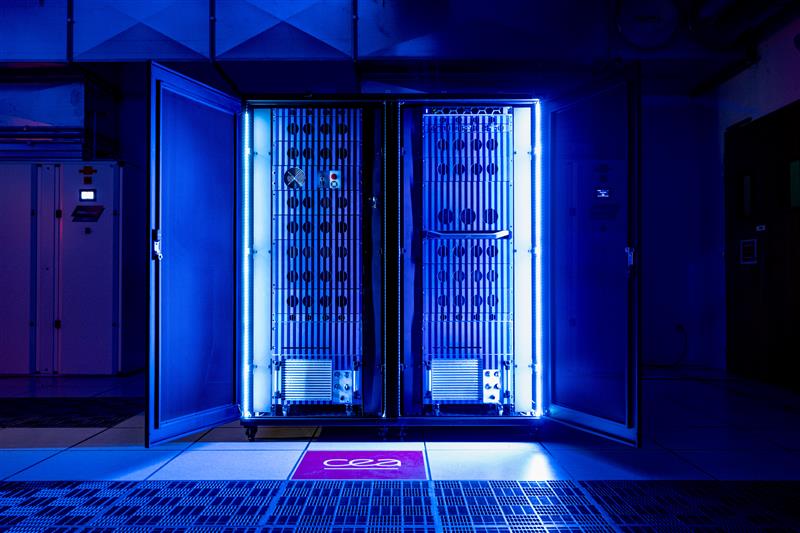
Four years on, the initiative has reached a new milestone with the inauguration of Lucy. Installed at the TGCC (Très Grand Centre de calcul) in Essonne since October 2025, Lucy is a universal quantum computer based on French company Quandela’s photonic technology, with cryogenic systems supplied by a German vendor. It is now coupled to Joliot-Curie, a 22-petaflop supercomputer, while awaiting connection to the exascale system Alice Recoque. The acquisition cost for Lucy came to €8.5 million.

Initial use cases include optimization of energy networks and financial portfolios, logistics management, and aerospace design.

Lucy is one of three quantum partitions built around Joliot-Curie, alongside Qaptiva and Ruby. TGCC’s classical HPC resources are open to scientific projects from both public and private sectors, but in all cases the work must lead to publication. Private-sector access is limited to companies with R&D activity in France. The same open-research rule applies to Lucy, but access is broader: any European researcher can apply, regardless of whether their lab or company has ties to France. Allocation is capped at 100 hours per year per quantum partition.

Qaptiva, supplied by Atos, provides access to a 40-qubit quantum emulator. Ruby, inaugurated in November 2025, is based on a 100-qubit neutral-atom analog quantum computer from Pasqal. Analog systems are particularly suited to combinatorial optimization problems such as store placement, map labeling and credit scoring, as well as physics-chemistry simulation and quantum machine learning, including time-series processing and graph-based classification.

Ruby’s inauguration was paired with another 100-qubit Pasqal system, JADE, installed at the Jülich Research Centre in Germany and connected to the JURECA DC supercomputer (23.5 petaflops). Both are part of HPCQS (High-Performance Computing Quantum Simulator hybrid), a European project focused on hybridizing HPC and quantum simulators. France, Germany, Austria, Spain, Ireland and Italy contribute funding alongside Horizon 2020 support.

Lucy was acquired through the EuroQCS-France consortium, which brings together CEA and GENCI with the Jülich Research Centre, ICHEC (Irish Centre for High-End Computing) and the Polytechnic University of Bucharest. EuroHPC selected this consortium in October 2022, alongside five others, to host its first quantum computers.

Those six EuroHPC hybrid systems are:

  • Piast-Q, at the Poznań Supercomputing and Networking Center in Poland, using trapped ions from Alpine Quantum Technologies, with 20 qubits, connected to ALTAIR (5.9 petaflops), cost €12.3 million, inaugurated in June 2025.
  • Euro-Q-Exa, at the Leibniz Supercomputing Centre in Munich, Germany, using superconducting qubits with square-lattice topology from IQM, with 54 qubits, connected to SuperMUC-NG (26.9 petaflops), cost €25 million, scheduled for February 2026.
  • VLQ, at IT4I National Supercomputing Centre in Ostrava, Czech Republic, using superconducting qubits with star topology from IQM, with 24 qubits, connected to KAROLINA (12.9 petaflops), cost €5 million, inaugurated in September 2025.
  • EuroQCS-Italy, at CINECA in Bologna, Italy, using neutral atoms from Pasqal, with 140 qubits, connected to Leonardo (315.74 petaflops), cost €13 million, not yet inaugurated.
  • Marenostrum Ona, at the Barcelona Supercomputing Centre in Spain, using a quantum annealing system from Qilimanjaro Quantum Tech, with 10 to 25 qubits, connected to MareNostrum 5 (314 petaflops), cost €8.5 million, not yet inaugurated.

Lucy therefore adds another concrete step to France’s broader hybrid-computing strategy, which aims to integrate quantum processors and simulators with major HPC infrastructure rather than treating them as separate computing worlds.

Résumé
L’initiative française HQI (Hybrid Quantum Initiative), dotée de 72,3 M€ (matériel via GENCI et programme de recherche CEA/Inria), franchit un nouveau jalon avec l’inauguration de Lucy, un ordinateur quantique universel photonique de Quandela installé au TGCC depuis octobre 2025 et couplé au supercalculateur Joliot-Curie (22 Pflops), en attendant Alice Recoque. Lucy (8,5 M€) vise notamment l’optimisation de réseaux énergétiques et de portefeuilles financiers, la logistique et la conception aérospatiale, avec un accès soumis à des exigences de recherche ouverte et à une limite de 100 heures/an par partition. Autour de Joliot-Curie, d’autres partitions quantiques (Qaptiva d’Atos et Ruby de Pasqal) et des projets européens comme HPCQS renforcent l’hybridation HPC/simulateurs quantiques, dans un consortium EuroQCS-France associant CEA, GENCI et des partenaires européens.

Constituer une plate-forme de calcul hybride HPC/quantique autour du supercalculateur Joliot-Curie : tel était l’objectif de l’initiative française HQI (Hybrid Quantum Initiative) à son lancement en janvier 2022.

Le budget global était de 72,3 M€. Une moitié pour l’acquisition de matériel sous la houlette de GENCI. L’autre pour un programme de recherche porté par le CEA et Inria.

Quatre ans plus tard, des jalons ont été franchis. Dont un cette semaine, avec l’inauguration de Lucy. Cet ordinateur quantique universel repose sur la technologie photonique de l’entreprise française Quandela –  les systèmes cryogéniques proviennent d’un fournisseur allemand. Il est installé au TGCC (Très Grand Centre de calcul, dans l’Essonne) depuis octobre 2025. Et couplé, donc, à Joliot-Curie (22 Pflops), en attendant le supercalculateur exaflopique Alice Recoque. Coût d’acquisition total : 8,5 M€.

Parmi les applications initiales de Lucy, on nous cite l’optimisation de réseaux énergétiques et de portefeuilles financiers, la gestion logistique et la conception aérospatiale.

Lucy, Qaptiva et Ruby, trois partitions quantiques autour de Joliot-Curie

Les ressources HPC classiques du TGCC sont ouvertes aux projets scientifiques émanant aussi bien de la sphère publique que de la sphère privée. Mais dans tous les cas, les résultats des travaux doivent donner lieu à publication. Pour le privé, l’accès est réservé aux entreprises qui disposent d’une activité de R&D en France.

L’exigence de recherche ouverte s’applique aussi pour l’accès à Lucy. En revanche, tout chercheur européen peut postuler, que son laboratoire ou son entreprise ait ou non un lien avec la France.

L’enveloppe allouée ne peut dépasser 100 heures par an… et par partition quantique. Lucy n’est effectivement pas seule. Il y a aussi, d’une part, Qaptiva, fournie par Atos, et qui donne accès à un émulateur quantique à 40 qubits. De l’autre, Ruby, inaugurée en novembre 2025, et qui repose sur un calculateur quantique analogique de à atomes neutres (100 qubits) signé Pasqal.

Parmi les applications qui se prêtent bien au mode de fonctionnement analogique figurent l’optimisation combinatoire (implantation de magasins, étiquetage de cartes, notation de crédit…), la simulation en physique-chimie et le machine learning quantique (traitement de données temporelles, classification sur des données en forme de graphes).

Parallèlement à Ruby a été inauguré un autre calculateur Pasqal à 100 qubits : JADE, installé quant à lui au Centre de recherche de Juliers (Allemagne) et connecté au supercalculateur JURECA DC (23,5 Pflops). En toile de fond, un projet européen axé sur l’hybridation entre HPC et simulateurs quantiques : HPCQS (High-Performance Computing Quantum Simulator hybrid). La France, l’Allemagne, l’Autriche, l’Espagne, l’Irlande et l’Italie y contribuent financièrement, en complément à des fonds du programme Horizon 2020.

Les 5 autres systèmes hybrides d’EuroHPC

Lucy a été acquis dans le cadre d’un consortium dit EuroQCS-France. Au CEA et à GENCI, il associe le Centre de recherche de Juliers, l’ICHEC (Irish Centre for High-End Computing) et l’université polytechnique de Bucarest. EuroHPC l’avait sélectionné en octobre 2022, aux côtés de 5 autres consortiums, pour héberger ses premiers ordinateurs quantiques. En l’occurrence :

Ordinateur

Emplacement

Technologie

Connecté à

Coût

Inauguration

Piast-Q

Poznań Supercomputing and Networking Center (Pologne)

Ions piégés (Alpine Quantum Technologies, Autriche)

20 qubits

ALTAIR (5,9 Pflops)

12,3 M€

Juin 2025

Euro-Q-Exa

Leibniz Supercomputing Centre (Munich, Allemagne)

Qubits supraconducteurs à topologie en réseau carré (IQM, Finlande)

54 qubits

SuperMUC-NG (26,9 Pflops)

25 M€

Février 2026

VLQ

IT4I National Supercomputing Centre (Ostrava, République tchèque)

Qubits supraconducteurs à topologie en étoile (IQM)

24 qubits

KAROLINA (12,9 Pflops)

5 M€

Septembre 2025

EuroQCS-Italy

CINECA (Bologne, Italie)

Atomes neutres (Pasqal)

140 qubits

Leonardo (315,74 Pflops)

13 M€

Non inauguré

Marenostrum Ona

Barcelona Supercomputing Centre (Espagne)

Système à recuit quantique (Qilimanjaro Quantum Tech, Espagne)

10 à 25 qubits

Marenostrum 5 (314 Pflops)

8,5 M€

Non inauguré

Illustration © Quandela

The post Lucy, un jalon quantique de plus dans la stratégie française de calcul hybride appeared first on Silicon.fr.
AI Insight
Core Point

法国HQI计划下的通用光量子计算机Lucy在TGCC落地并与Joliot-Curie耦合,推动HPC+量子混合计算路线并为后续exaflop级Alice Recoque铺路。

Key Players

HQI(Hybrid Quantum Initiative) — 法国混合HPC/量子平台建设项目(2022启动)。

GENCI — 负责采购硬件的法国HPC组织,总部法国。

CEA — 牵头量子研究项目(法国)。

Inria — 参与量子研究项目(法国)。

Quandela — 法国光子量子技术公司,提供Lucy量子计算机(法国)。

TGCC(Très Grand Centre de calcul) — 法国大型计算中心,Lucy安装地(埃松省)。

Joliot-Curie — TGCC的HPC超算(22 Pflops),与Lucy耦合。

Atos — 提供Qaptiva量子仿真器(40 qubits)(法国/欧洲)。

Pasqal — 提供Ruby与JADE的中性原子模拟/量子计算系统(总部法国)。

EuroQCS-France(联盟) — Lucy所在联盟:CEA/GENCI与Juliers、ICHEC、布加勒斯特理工等。

EuroHPC — 欧洲量子计算机遴选与部署(欧洲)。

ICHEC — 爱尔兰高端计算中心(爱尔兰)。

Juliers研究中心(C. de recherche de Juliers) — 德国部署JADE并接入JURECA DC。

HPCQS — 欧洲HPC+量子模拟混合项目(多国参与,Horizon 2020资金)。

Industry Impact
  • Computing/AI: High — HPC与量子(光子/模拟/仿真)耦合落地,面向优化、仿真、量子ML等应用。
  • ICT: Medium — 量子计算基础设施与跨国平台部署增强欧洲算力生态。
  • Energy: Medium — 能源网络优化成为Lucy初始应用方向。
  • Automotive: Low — 设计/仿真类任务可能间接受益(文中提及aérospatiale而非汽车)。
Tracking

[Strongly track] — Lucy与Joliot-Curie的混合耦合、以及与EuroHPC/多国量子系统的联动,可能显著影响法国与欧洲量子算力路线与产业可用性。

Highlights
Tech Breakthrough Investment / Funding Local Research
Categories
人工智能 云计算 创业 科研
AI Processing
2026-04-17 19:30
openai / gpt-5.4-nano